
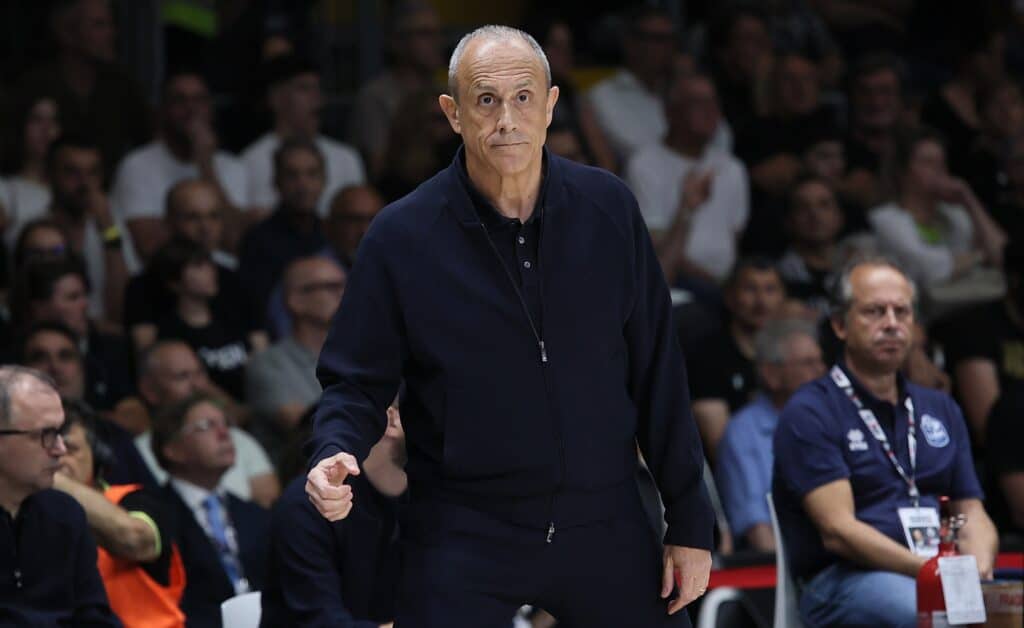
In the last part of the interview, Ettore Messina talks to us about the young talents that he got to know closely in Milan and who have now moved to the NCAA, from Quinn Ellis to Luigi Suigo.
CLICK HERE FOR THE SECOND PART
His son Filippo will still be in Durham, who is building his career in the front office of Duke and, starting from his words, we arrive at the future. Which could be in an American college.
CLICK HERE FOR ITALIAN VERSION
At 23 years old and after a season as a Euroleague starter, Quinn Ellis opened the eyes of many to the economic power of the NCAA. Did his decision to go to St. John’s surprise you and what will be his impact in college?
It amazed me to the extent that I clearly saw he was a guy destined to become an important Euroleague player within a couple of years. It does not surprise me at all that this is for him the fastest way to get back close to the NBA, given that he was not chosen in the Draft. There were rumors of possible transfers towards prestigious programs like Duke or St. John’s, contexts that for different reasons offer a well-defined channel to eventually arrive in the NBA. These are programs constantly monitored by the scouts of all the main franchises, they go on television a lot of times and face a schedule of the highest level. If you do well, you have an important interest from the NBA world. He was not chosen and goes to play in New York which at this moment is under the spotlight of everything and everyone.

I believe he will do well, given the maturity he has, the athleticism, the experience given that he played a season in Euroleague against opponents of the highest level every week. He can count on an excellent coach and on a program where at this moment everyone is pumped up like they haven’t been in a long time. If he does well there, he will surely have a chance to land in the NBA. In light of this reasoning, I understand and am little surprised.
You also got to know well three guys who were part of the very strong 2007 class of Olimpia. Last year they took different paths and now find themselves in the NCAA. The first to arrive was Achille Lonati, did you expect him to have so little space at St. Bonaventure?
They are three situations, as you know very well, very different from each other. Lonati chose a medium-level college, where however he can improve and gradually find space. Beyond the contract, his was the classic first year as a freshman, when you have to earn consideration in everything, when playing is difficult, when finding minutes is not easy and surely the second year he will play more and will be able to harvest a bit of satisfaction. If they had not been happy, they would have made him understand that it would have been better to look for another arrangement. The fact that this did not happen demonstrates that both the technical staff and Wojnarowski (the GM of St. Bonaventure) have confidence in him. In the second year he will have strengthened physically and technically, he will have more experience and will do the typical run of the player who will grow in college.
Luigi Suigo thought about it for a long time and then made the choice of many, like for example Dame Sarr: better a year of NCAA than a choice in the second round of the draft. What will be his impact at Villanova and what his role in the national team?
Compared to Lonati, the case of Suigo is different. He made a choice that led him to have an experience outside of his country, at Mega Basket where they have an excellent structure and an excellent organization and where they program very well the career of these players under the guidance of an experienced manager like Miško Ražnatović, whether it is Nikola Jokić or young guys. Rather than trying to take a non-positive choice in the second round of the Draft, they preferred to send him to an excellent program like Villanova and put him to the test in a university context.

One could object that before he was in Milan, then in Serbia and now he changes again… it is a career programming and anyway he also relied on very experienced people who will certainly know how to best manage his growth.
The last one is Diego Garavaglia, who instead remained for a long time in doubt between America and Europe: how do you evaluate his final choice to go to Rutgers?
Diego is exactly the living proof of what I was telling you before. He is an excellent guy, a versatile player, with ample margins for improvement, who did very well in our youth national teams and at Ulm struggled to find with continuity the space that a player of that age would like to have, should have, but that is difficult to give him. Not by fault of whoever coaches him, not by fault of his, not by fault of the club, but simply by a matter of fact. The jump from what he did in youth competitions until the year before to the Eurocup and to the top of a good league like the German one is enormous. It is nobody’s fault, it is an enormous jump.
And now in my opinion he made the very intelligent choice to go to college. Calmly, he will do an experience in between and will do it well, and this will make him grow also because, I repeat, Diego is a guy of extreme professionalism, he is a very serious guy, at the end of June he was in the gym sweating with the trainer Beppe Mangone, always with a smile on his lips. At Rutgers he will find the ideal opportunity and the experience accumulated so far in Europe will allow him to have an impact since his first year.
These are guys that Olimpia raised and valued and then lost, and it is obviously a theme that concerns all the youth sectors of European clubs. Also Barcelona has just lost two other talents raised in its youth sector until the age of 17. Has the moment arrived for Europe to do something and protect itself from the contractual point of view?
It is not the individual clubs, but sports politics in general to have been caught by surprise by this phenomenon. Even the American government remained surprised and still today has not managed to launch an effective regulation. Consequently, it is all too easy to point the finger and state that Fiba, the Leagues or the individual federations had to do this or that.
We remained so surprised by the level of impact that this thing has assumed, especially as far as the economic offers are concerned, nobody could think of a thing like that. We remained surprised, now it is being talked about more frequently, but I repeat however that even the American government did not know where to put its hands, despite having this extremely interventionist president. Let’s hope they find a solution.
In the meantime, the most important aspect is to program well the return of these guys to Europe. Not everyone will manage to go to the NBA, if 10% goes it is already a lot. We must be ready to manage their return when the university eligibility will end, but these guys will have done an important experience and have improved.
In addition to the players, there are also young people who choose America to train as coaches or managers inside the universities. Let’s think of Riccardo Fois or your son Filippo, who will remain at Duke. You who have often frequented the Duke environment and know Jon Scheyer well, what kind of reality did you find in Durham and what impression did their head coach make on you?
I care to say that my son Filippo does not want to be a coach, but another career in the front office. He is very happy to collaborate with the team, but he deals a lot with international scouting and all that part. And I am happy about this choice of his, so he can be independent and autonomous in what he does, otherwise there is always the risk of being ‘son of’. Everything he is earning, he is earning it by himself.
Jon Scheyer is a person of excellent level. I met him and developed, I believe, an excellent friendship thanks to Quin Snyder who had been coached by Scheyer when he was associate coach of Coach K. They maintained a very strong bond and a deep friendship. It was precisely Quin who changed a bit the project for Filippo, who initially was orienting himself towards Davidson or Virginia for his university studies. When this opportunity opened up, we went to visit the Duke campus and Filippo had an interview with Scheyer.
Jon is perfectly in line with the needs of modern basketball: he has great energy and is extremely competent both from the technical and tactical point of view. During the games he has a remarkable capacity to call plays and to read situations on the run, without calling timeouts. He is extremely communicative and extremely quick in making decisions. The solutions he proposes coming out of time-outs are very often efficient and very often interesting, whether it is about plays for the shooters or for the best player he has on the court.
And he has a beautiful capacity to communicate with the guys, not only for the age but because it comes natural to him. He managed to develop his own method of work which is different from that of Coach K, while maintaining a very important ideal bond, having been for many years both his player and his assistant. The current imprint of the program is autonomous, it is his. He has already lost two assistants who became head coaches in other universities, and this says a lot about the impact he had.
He discussed until a few days ago the possibility of going to Dallas, where he would have found Cooper Flagg, Derek Lively, etc. If an executive of the caliber of Masai Ujiri tries to take him, it means that there is already an enormous consideration inside the NBA. Jon has a beautiful presence on the court and is destined for an enormous career, whether he chooses to stay for 20 years at Duke, or decides to make the jump among the professionals. He can afford to await the best team, if he will want to make the jump to the NBA, also because he is in a program among the top three at a national level, not only for the players that arrive every year but for the organization and the fan base. Then it’s two years in a row that after having had a very great season, they did not manage to concretize and win the title, which was within their reach. But this, for better or for worse, is the charm of college basketball.
You owe an answer to your son Filippo, who last year had told us smiling that you are by now “too old” to coach in the NCAA.
Filippo is right, surely (laughs). I should have done it many years ago and it would have been a beautiful experience. I remember that when I was the assistant of Sandro Gamba, in the period in which he left the guidance of the senior National team before moving to Bologna, he had received an offer to go to coach a college. I remember that he had thought about it a lot, I had precisely perceived it from the outside. Thinking back about it, those are beautiful opportunities.
It is not a mystery that you look with great interest at this world and you received proposals from some American universities recently. How much does the idea of an experience in the United States fascinate you and how concrete is this possibility?
I did not receive offers to coach in college but to give a hand, which is different. It could be a very interesting thing and I would like to do it. Sincerely I have not cleared my ideas, you will say ‘you are a bit slow’ and you are right (laughs), however I want to take the necessary time to try to make the best choice.